Hunter vs applying by hand
What a tailored resume and an AI interviewer save you each week, and where the human touch still matters most.

Hunter does the repetitive parts of a job search for you: finding openings across career sites and job boards, scoring each one against your real experience, writing a tailored resume for every application, filling in forms, and tracking replies. Applying by hand gives you full control and a personal touch, but it’s slow, and that slowness usually means sending fewer, less tailored applications. Most people do best with both: Hunter for the volume, by hand for the handful of jobs that matter most.
At a glance
| Hunter | Applying by hand | |
|---|---|---|
| Finding jobs | Searches career sites and boards on a schedule | You search each site yourself |
| Duplicates | Merged automatically | You notice them, eventually |
| Fit check | Match score with strengths and gaps | Your judgment, job by job |
| Tailored resume | Written for every job from your experience bank | You edit one by hand, if there’s time |
| Truthfulness | Fact-checked, every change highlighted | Up to you |
| Filling in forms | Done for you from saved answers | Typed again on every site |
| Job site logins | Created and saved in an encrypted vault | A sticky note, or “forgot password” again |
| Tracking replies | From Gmail, automatically | A spreadsheet, if you keep one |
| Interview practice | AI mock interviews with a scorecard | A friend, a mirror, or nothing |
| Personal touch | Lower | Higher |
| Cost | Free during early access, plus your AI plan | Your time |
Where the time goes when you apply by hand
Think about a single good application. You find the posting, read it closely, decide whether it fits, rework your resume to match, maybe write a cover letter, create yet another account on the company’s hiring site, and retype your work history into its form. Then you log it somewhere so you can follow up. Done carefully, that can easily take half an hour or more. Most of it isn’t thinking. It’s copying.
Multiply that by the number of applications a search often needs, and two things tend to happen. People send fewer applications, or they send the same untailored resume everywhere. Neither helps.
What Hunter does instead
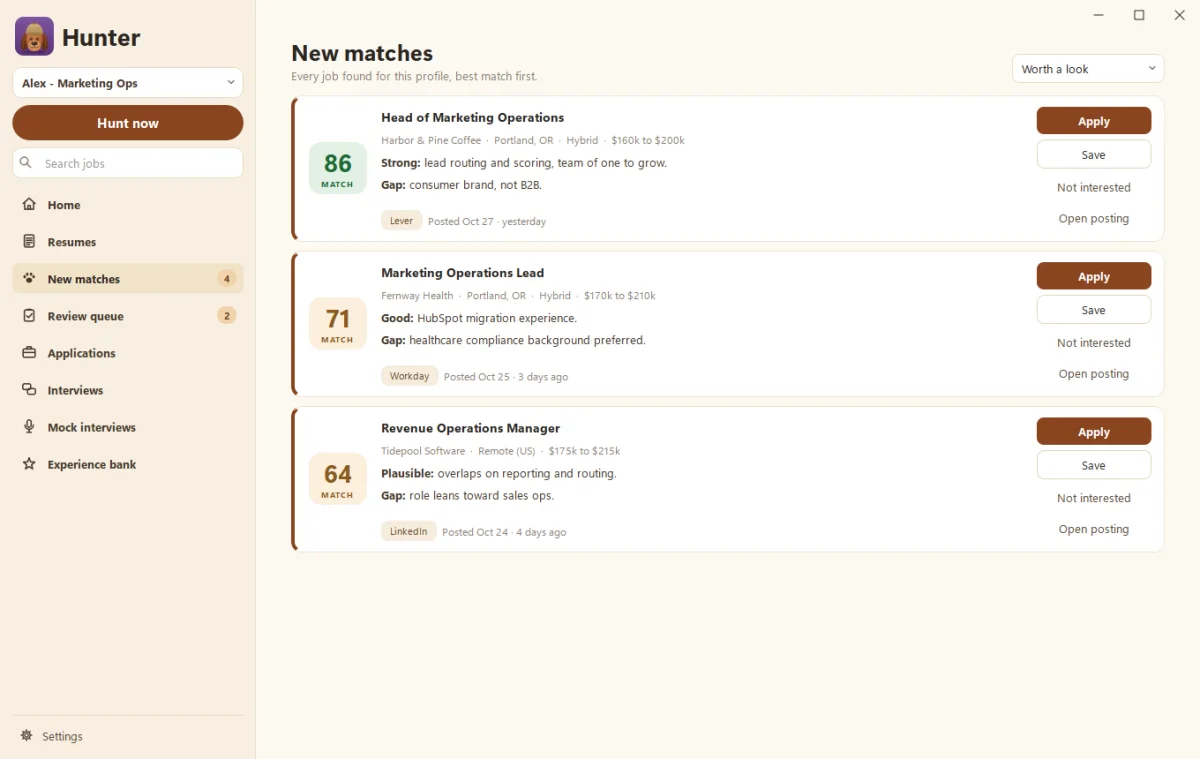
- Finds the jobs. Hunter checks Greenhouse, Lever, Ashby, Workday and other career sites, plus public job boards and a watch list of companies you like, on a schedule you choose.
- Tells you which ones fit. Every job gets a match score with the strengths and gaps behind it. Deal-breakers are skipped for you.
- Tailors the resume, honestly. Hunter writes from your experience bank only, then fact-checks. Every reworded line is highlighted, and you can hover to see your original words. See Tailored resumes and the fact check.
- Fills in the form. Your standard answers, contact details and resume go in on the company’s own site. Hunter creates the account if needed and locks the login in your vault.
- Tracks the replies. With Gmail connected, rejections, interviews and offers update each application on their own.
- Gets you ready. Prep sheets and AI mock interviews, typed or out loud, with a scorecard at the end.
You stay in control. Practice mode keeps Hunter from submitting anything on its own until you’ve watched it work and turned it off. Even then, only strong matches go out automatically, up to a daily limit you set.
Where applying by hand still wins
We’d be barking up the wrong tree if we said a tool beats a person at everything. Apply by hand when:
- It’s a dream job. Research the team, write a cover letter only you could write, and find someone to talk to.
- You have a referral. A warm introduction beats any application. Hunter can even help you find people at the company to ask.
- The company is tiny. No hiring system, just an email address and a founder who reads every message.
- The role is creative. Portfolios, case studies and personal sites need your touch.
The best of both
Let Hunter handle the volume, the forms and the follow-up, and spend the hours you save on the few applications, conversations and interviews that need you. Start by building your experience bank, then run your first hunt.
Questions people ask
Will Hunter apply to jobs without asking?
Not unless you allow it. Practice mode is on until you turn it off, so Hunter never presses Submit on its own until then.
Does Hunter make up experience?
No. It writes only from your experience bank, fact-checks the result, and highlights every reworded line.
Is applying by hand ever better?
Yes. For dream jobs, referrals, very small companies and creative roles, a personal approach often beats any tool. Hunter frees up time for exactly those.
Still scratching your head?
Send us a note and a real person will get back to you.