How to tailor your resume for every job without stretching the truth
A simple method for matching each posting using only what you've really done.

To tailor your resume honestly, start from a master list of everything you’ve really done, then for each job pick the most relevant true items, put them first, and describe them in the posting’s language. You change the order, the emphasis and the wording. You never change the facts. That’s it. The rest of this post is how to do it well, and how to do it fast.
Why tailor at all?
Two readers decide whether you get an interview:
- Hiring software, which many companies use to sort applications, often by how well they match the posting.
- A busy human, who gives your resume a quick first look before deciding whether to read it properly.
Both reward a resume that clearly matches the job. A generic resume makes them do the matching. Most won’t.
The honest tailoring method
1. Build a master list first
Before you tailor anything, write down everything: every job, project, result, tool and number you can remember, even the ones that never fit on a resume. This is your experience bank. It should be long and messy. Think of it as the pantry, not the meal.
Good sources:
- Old resumes and performance reviews
- Your LinkedIn profile
- Project docs, launch emails, “wins” channels
- Meeting notes, where real results get mentioned and then forgotten
2. Read the posting like a checklist
Go through the job posting and pull out:
- Must-haves: the skills and experience they clearly require.
- Nice-to-haves: the “bonus points” list.
- Their words: the exact phrases they use, like “go-to-market”, “stakeholders” or “B2B SaaS”.
- The level: are they hiring someone to do the work, lead it, or set the strategy?
3. Match, don’t invent
For each must-have, find a true item in your experience bank that proves it. Put the strongest matches in your most visible spots: the summary, the top bullets of your latest job, and the skills section.
If there’s a must-have you can’t match, leave it. Don’t invent it. You’ll talk about the gap honestly in the interview, or decide the job isn’t right. A resume that gets you an interview you can’t survive isn’t a win.
4. Rewrite in their language, carefully
Now reword your matches using the posting’s vocabulary, but only where it’s accurate:
- Before: “Ran the weekly sync between sales and product.”
- After (for a job asking for cross-functional leadership): “Led weekly cross-functional planning between sales and product teams.”
Same fact. Better fit. The line between tailoring and fibbing is simple: could you comfortably explain this line in an interview, with an example? If yes, it’s fair. If you’d start sweating, rewrite it.
5. Lead with results
Hiring managers skim for impact. Where you can, show what changed because of you:
- “Cut onboarding time from 3 weeks to 9 days”
- “Grew the newsletter from 2,000 to 11,000 subscribers”
- “Closed 14 enterprise renewals worth $1.2M”
Only use numbers you can stand behind. Approximate is fine (“about 40%”). Made up is not.
6. Cut what doesn’t help
Tailoring is also subtraction. That impressive but unrelated project? It can shrink to one line, or go. Older jobs can fold into a short “Earlier experience” line. A focused resume beats a complete one.
7. Check it against the original
Before you send it, read every changed line next to your original wording. Did anything drift from “helped with” to “led”? From “about 30%” to “45%”? Fix it. This step catches the small, honest-mistake exaggerations that creep in when you’re tired and trying to impress.
A worked example
Say the posting is for a Marketing Operations Manager, and it asks for “experience owning the marketing tech stack”, “reporting on pipeline for leadership” and “partnering with sales”. Here’s part of an experience bank:
- Set up HubSpot for a 40-person company and migrated 18,000 contacts from spreadsheets.
- Built a weekly dashboard of leads and pipeline that the CEO used in board meetings.
- Ran a monthly meeting with sales to agree on what counts as a qualified lead.
- Organized the company holiday party for three years.
- Wrote 30 blog posts about industry trends.
What gets tailored:
- The HubSpot item moves to the top and gets their words: “Owned the marketing tech stack: implemented HubSpot for a 40-person company and migrated 18,000 contacts from spreadsheets.”
- The dashboard becomes: “Built weekly pipeline reporting for leadership, used by the CEO in board meetings.”
- The sales meeting becomes: “Partnered with sales leadership monthly to define and refine lead qualification.”
What gets cut or shrunk: the holiday party goes (sorry, party). The blog posts shrink to a single line further down, or drop out if space is tight.
What doesn’t happen: if the posting also asks for “Salesforce administration” and you’ve never administered Salesforce, it doesn’t appear. Not even as “familiar with”. If you’ve used it as a regular user, you can say exactly that, in the skills section, and be ready to talk about it.
Notice what changed: the order, the emphasis, and the vocabulary. Notice what didn’t: every fact. Every line could be defended in an interview with a real story.
Keep the format machine-friendly
Hiring software is better than it used to be, but simple still wins:
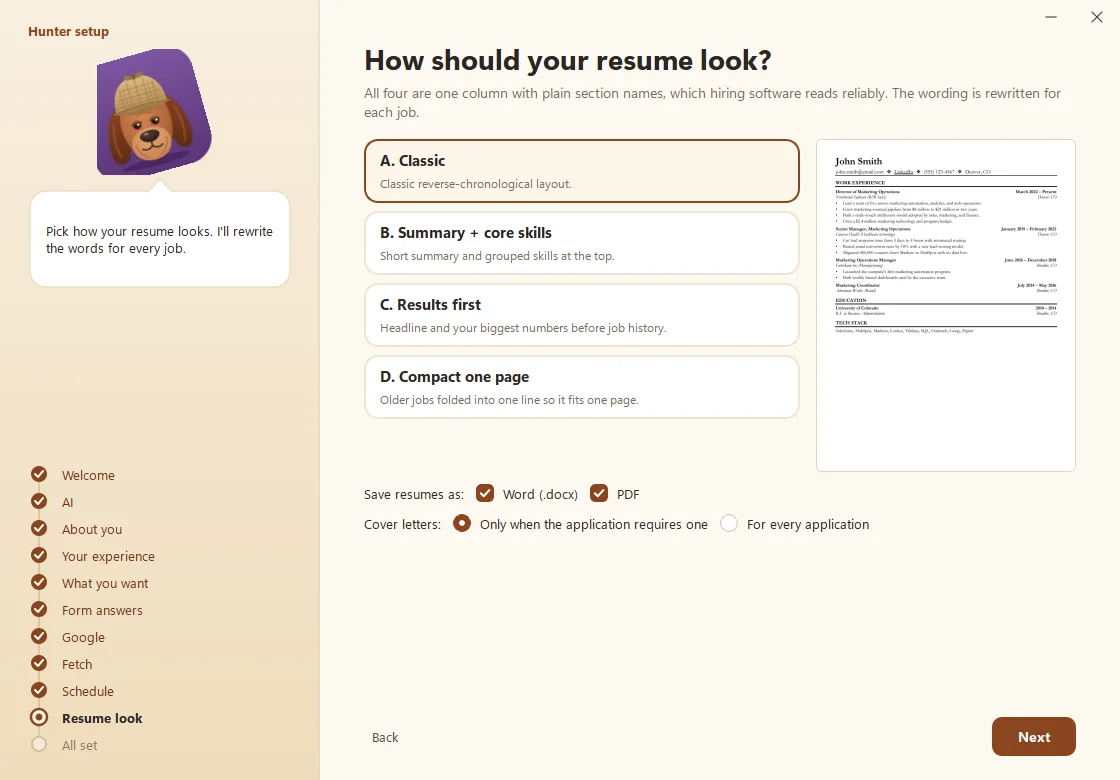
- One column, with plain section names like “Experience”, “Education” and “Skills”.
- No text in images, tables or text boxes.
- Standard fonts and a Word or PDF file.
- Dates on every job, in a consistent format.
What about cover letters?
The same rules apply, in paragraph form. A good tailored cover letter does three things in under 300 words:
- Says why this company and this role, specifically. One real detail beats three compliments.
- Tells one short story from your experience that proves you can do the most important part of the job.
- Closes simply, with interest in talking further.
If an application doesn’t ask for a cover letter, it’s usually fine to skip it and put that energy into the resume. If it does ask, never send a generic one. “Dear Hiring Manager, I am excited to apply for this position” is the cover letter equivalent of a shrug.
How to do this without spending all week on it
Done by hand, careful tailoring takes real time per application. That’s why most people stop doing it after the third job. Some ways to speed it up:
- Keep your experience bank up to date as you go, so you’re never starting from scratch.
- Save your best bullet variations. You’ll reuse “cross-functional leadership” more than once.
- Tailor harder for better fits. A perfect match deserves 30 minutes. A long shot gets 5.
- Use a tool that writes only from your real experience. That’s what Hunter does. It writes each resume from your experience bank, highlights every reworded line so you can compare it with your own words, and runs a fact check before anything is sent. See Tailored resumes and the fact check.
A quick tailoring checklist
- Started from a complete experience bank
- Every must-have that you truly meet is visible near the top
- The posting’s language is used where it’s accurate
- Results and numbers are real, and you can explain each one
- Unrelated items are shortened or cut
- Every changed line was checked against the original
- The format is one column, with plain section names
The bottom line
Tailoring isn’t spin. It’s editing: choosing which true story to tell first, for this reader. Do it honestly and you’ll never have to remember which version of yourself you sent where. And when the interview comes, practice telling those stories out loud. We’ve got a list for that: 10 interview questions to practice out loud this week.
Questions people ask
Is it dishonest to change my resume for each job?
No, as long as every line stays true. Tailoring is choosing which true things to put first and describing them in the employer's language. Inventing skills, titles or numbers is where it crosses the line.
Should I copy keywords from the job posting?
Use the posting's words when they accurately describe what you did. If they ask for "stakeholder management" and you led cross-team projects, say so in their words. Don't add keywords for things you haven't done.
How long should a tailored resume be?
One page for most people early in their career, two pages for more experience. Tailoring often makes a resume shorter, because you cut what doesn't matter for this job.
Still scratching your head?
Send us a note and a real person will get back to you.