Hunter for career changers
Your experience counts. Hunter helps you show it in the language of the job you want next.

Changing careers means explaining, over and over, why your past makes you good at something new. Hunter helps with the three hard parts: translating your experience into the new field’s language, finding roles worth a shot, and practicing interviews until the story feels natural.
Start with everything you’ve done
Hunter writes resumes only from your experience bank. Fill it with your old resume, your LinkedIn profile as a PDF, rough notes, or stories you say out loud. Hunter sorts it into jobs, results and skills, then asks a few questions about numbers, like how many, how much, or how fast. Those numbers are what make a teacher’s “designed courses for 1,200 students” land with an instructional design team. See Build your experience bank.
Resumes in the new field’s words
For every job, Hunter writes a resume tailored to the posting, putting your most relevant experience first and using the job’s language where your experience truly matches. It never adds skills, titles or numbers you don’t have, and a fact check catches anything that drifted. Reworded lines are highlighted so you can see exactly what changed. See Tailored resumes and the fact check.
Doing it by hand? Our free resume keyword checker shows which of a job’s keywords your resume is missing.
Find roles that fit
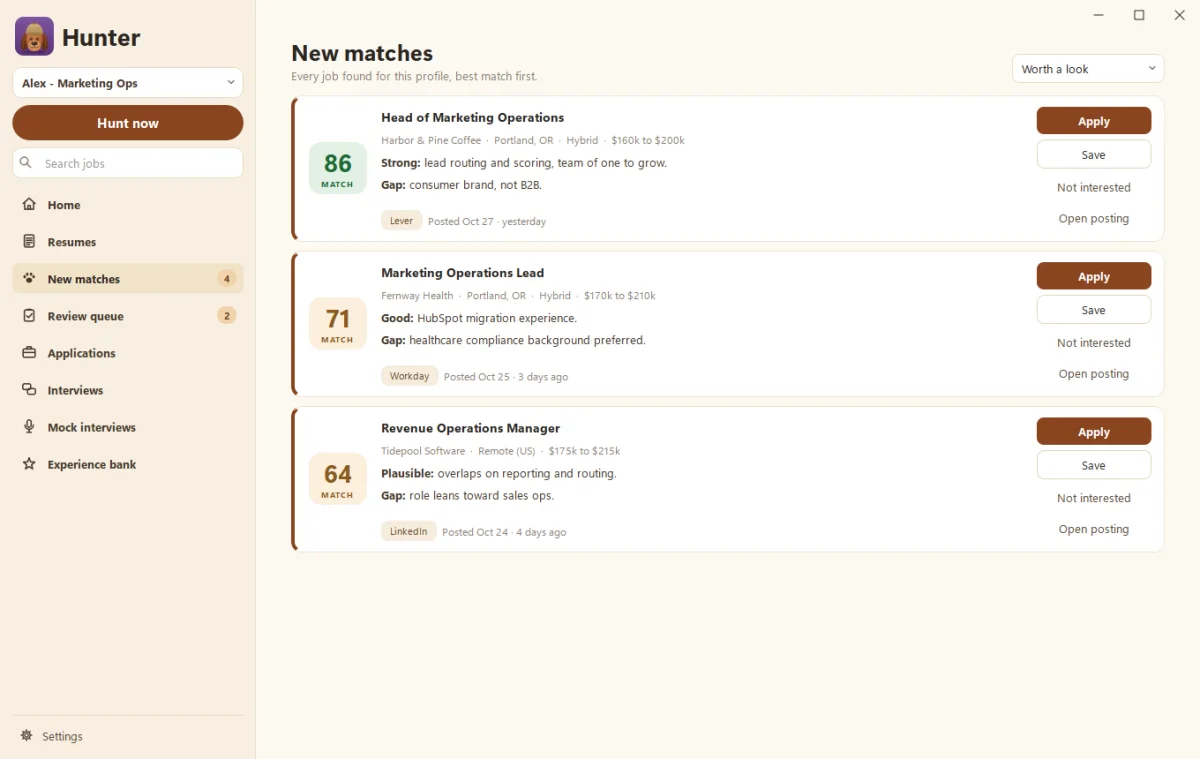
Set the titles you’re aiming for, the seniority, work style, locations and salary floor. Hunter searches company career sites and job boards on a schedule, and scores every job against your experience. Each job shows its strengths and gaps. For a career changer, gaps are expected. Read them as “things to address in the interview”, not reasons to give up. See match score.
Practice the “why the switch?” question
You’ll be asked why you’re changing careers in nearly every interview. Hunter’s mock interviews let you practice for a specific job, typed or out loud, with an AI interviewer who follows up. The scorecard shows what worked, what to try, and a stronger version of each answer. Strong stories are saved to your experience bank. See Practice a mock interview.
Before each real interview, make a prep sheet with likely questions, your best stories and questions to ask them.
You stay in control
Hunter starts in practice mode: it fills in applications but never presses Submit. When you’re ready, you can let it submit only your strongest matches, with a daily limit you set. Everything else waits in your Review queue.
What it costs
Hunter is free during early access, on Windows 10 and 11. It uses your own Claude or ChatGPT plan for the writing and scoring.
Questions people ask
Will Hunter make up experience I don't have?
No. Hunter writes only from your experience bank, and a fact check compares every resume with it. Reworded lines are highlighted so you can check them before anything is sent.
Can I search for several kinds of roles?
Yes. Add more than one job title, and use hunt profiles to search for different kinds of roles on their own schedules.
How do I practice for a field I haven't worked in?
Run mock interviews for the exact job posting. Hunter picks questions for the role and level, and you can choose types like hiring manager or skills deep dive.
Still scratching your head?
Send us a note and a real person will get back to you.