10 interview questions to practice out loud this week
The questions that come up most, and how to answer them with real stories.

The interview questions that come up most are predictable: “Tell me about yourself”, “Why this job?”, and a handful of “Tell me about a time…” questions. The best way to prepare isn’t memorizing answers. It’s picking a real story for each and saying it out loud until it’s clear and under two minutes. Here are ten to practice this week, with what the interviewer is really asking.
How should I answer story questions?
Use STAR: Situation, Task, Action, Result.
- Situation: one or two sentences of context.
- Task: what you needed to do.
- Action: what you did. This is the main part, so say “I”, not “we”.
- Result: what happened, with a number if you have one, and what you learned.
1. “Tell me about yourself.”
What they’re asking: Give me a quick, relevant summary, and a reason to keep listening.
How to answer: Present, past, future, in about a minute. What you do now, a highlight or two that got you here, and why this role is the natural next step. Skip your childhood. Skip your entire job history.
2. “Why do you want this job?”
What they’re asking: Did you do your homework, and do you actually want this job?
How to answer: Connect three things: something specific about the company, something specific about the role, and something specific about you. “I like your mission” is a start. Saying which part of the work excites you, and why you’re good at it, is the rest.
3. “Tell me about a time you solved a difficult problem.”
What they’re asking: How do you think when things get hard?
How to answer: Pick a problem with real stakes, and spend most of your time on how you figured it out. Interviewers love hearing about the wrong turn you took and corrected.
4. “Tell me about a time you disagreed with someone.”
What they’re asking: Can you push back without blowing things up?
How to answer: Choose a real disagreement about work, not personalities. Show that you listened, made your case with evidence, and stayed constructive, whether or not you won.
5. “Tell me about a time you failed.”
What they’re asking: Are you honest, and do you learn?
How to answer: Use a real failure, not a humblebrag (“I just care too much”). Own your part, keep the setup short, and spend the last third on what you do differently now.
6. “What’s your greatest strength?”
What they’re asking: What will you be great at here?
How to answer: Pick one strength that matters for this job, and prove it with a short story. One strength with evidence beats five adjectives.
7. “Tell me about a project you’re proud of.”
What they’re asking: What does great work look like to you?
How to answer: Choose something close to the job you want. Explain your role, a decision you made, and the result. Enthusiasm is allowed. Encouraged, even.
8. “How do you prioritize when everything is urgent?”
What they’re asking: Will you drown or decide?
How to answer: Describe your actual method, like impact versus effort, deadlines, or checking with your manager, then give an example of a week where you used it.
9. “Where do you see yourself in a few years?”
What they’re asking: Will you stick around, and does this role fit your path?
How to answer: Talk about the skills you want to build and the problems you want to own, and how this role helps. You don’t need a five-year plan. You need a direction.
10. “Do you have any questions for us?”
What they’re asking: Are you curious, and are you evaluating us too?
How to answer: Always say yes. Good ones:
- “What does success look like in the first 90 days?”
- “What’s the hardest part of this role?”
- “How does the team decide what to work on next?”
Avoid questions the website already answers.
Where do the stories come from?
From your real work, and it’s easy to forget the good ones. Before practicing, list five or six stories that show different strengths: a hard problem, a disagreement, a failure, a win you’re proud of, a time you led. Many questions can reuse the same strong story told from a different angle.
If you record meetings with Fetch, your past calls are full of forgotten wins. Hunter can look through them for stories and numbers, with your approval (see Prep for interviews with your Fetch notes).
How to practice this week
- Pick three questions a day. Ten questions over four days, then a full run-through.
- Say each answer out loud, and time it. Aim for one to two minutes.
- Listen back, if you can. Notice filler words and long setups.
- Do one realistic run with someone asking follow-up questions, because real interviewers dig deeper.
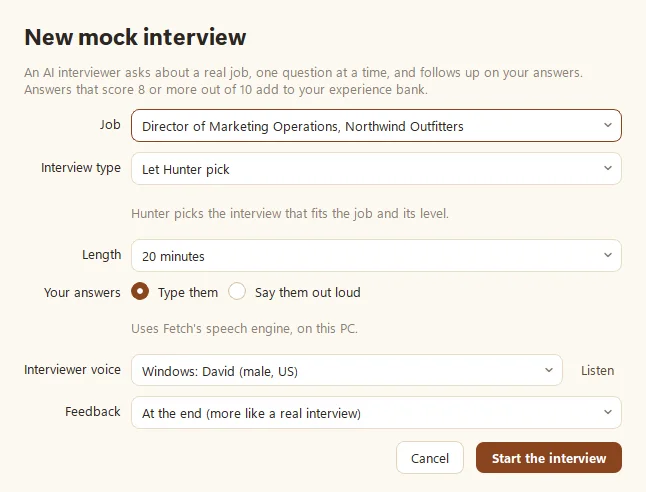
No practice partner? Hunter’s mock interviews give you an AI interviewer for the job you’re applying to, in styles from recruiter screen to panel. Answer by typing or out loud, and get a scorecard covering what went well, what to work on, your pace and your filler words. Pair it with a prep sheet of likely questions and your best stories.
Good luck. You’ve got this. And remember, they invited you because they already think you might be the one.
Questions people ask
Why practice out loud instead of in my head?
Because answers that sound great in your head often come out long and wandering. Saying them out loud is the only way to find out, and to fix it.
What is the STAR method?
A simple shape for story answers. Situation, Task, Action, Result. Set the scene, say what you needed to do, explain what you did, and share what happened.
How long should an answer be?
Most answers land well at one to two minutes. If you're past three, you're probably telling the backstory to the backstory.
Still scratching your head?
Send us a note and a real person will get back to you.