Budgeting on an uneven income: a freelancer's guide
How to give every dollar a job when paychecks don't arrive on schedule.

To budget on an uneven income, only budget money you already have, build your plan around a baseline month you can survive on, and keep a buffer that lets you pay yourself the same amount every month no matter when clients pay. Set aside taxes first, cover the baseline second, and give any extra a job only after it lands. It’s the same “every dollar gets a job” idea as any good budget, with the jobs assigned when the dollars show up, not when you hope they will.
Why normal budgets break on freelance income
Most budgeting advice assumes a steady paycheck: the same amount, twice a month, forever. Plan around that number, done.
Freelance income doesn’t work like that. You might earn $9,000 in March, $2,400 in April and $6,100 in May. Budget around March and April hurts. Budget around April and you feel broke in a good month, then splurge out of relief. Neither feels great, and the stress isn’t really about money. It’s about not knowing.
The fix is to stop budgeting money you expect and start budgeting money you have.
Step 1: Find your baseline
Your baseline is the minimum you need for a normal month:
- Housing, utilities, insurance
- Groceries and transportation
- Minimum debt payments
- Health care
- Phone and internet, if you need them for work
Leave out vacations, gadgets and nice dinners for now. Those come later. The baseline is “what keeps the lights on and the dog fed”.
Then look at the last 12 months of income and find your lowest typical month. Ignore the one truly bizarre month, but be honest. If your baseline is below your lowest typical income, good news: you have a workable plan. If it’s above, that’s important to know now, and the steps below still help.
Step 2: Take taxes off the top
This is the step freelancers regret skipping. As a freelancer in the US, nobody withholds taxes from your pay, so you typically pay quarterly estimated taxes yourself. That includes self-employment tax on top of income tax.
Every time a client pays you, move a set percentage into a separate tax account before you do anything else. Many freelancers use 25 to 30 percent of profit, but your right number depends on your situation. An accountant can give you one in a single conversation, and it’s money well spent.
Treat that tax money as gone. It isn’t yours. It’s just visiting. For the details, read Quarterly taxes for freelancers, explained simply.
Step 3: Build a buffer, then pay yourself a salary
Here’s the trick that changes everything. Instead of living off whatever came in this month, you live off last month’s income, or better, a fixed “salary” you pay yourself from a buffer.
- Keep a holding account where all client payments land, after taxes are set aside.
- On the 1st of each month, pay yourself a fixed amount from it, your baseline plus a little.
- Good months refill the holding account. Lean months draw it down.
The goal is a buffer of at least one full month of baseline expenses, then, over time, three months. Once you have it, a slow month stops being an emergency. It’s just a slow month.
Getting there takes a while, so start small. Every good month, send some extra to the buffer before anything else.
Step 4: Budget only money that’s arrived
When money hits your account, give every dollar a job, in this order:
- Taxes, already moved in step 2.
- Baseline categories for this month, if they aren’t covered.
- True expenses: bills that don’t come monthly, like car insurance, annual software or holiday gifts. Divide each by 12 and set that much aside every month.
- The buffer, until it hits your target.
- Goals and fun: savings, travel, that new laptop.
Invoices you’ve sent but haven’t been paid for don’t count yet. Budgeting money that hasn’t arrived is how lean months turn into credit card months. Wait for the deposit, then assign it.
Step 5: Plan for both kinds of months
Write down two plans in advance, so you’re not making decisions under stress:
- A lean month: what gets paused first? Dining out, subscriptions, extra savings contributions.
- A great month: where does the extra go first? Buffer, then debt, then goals.
Having a “great month” plan matters as much as the lean one. Without it, windfalls tend to evaporate.
What about debt?
Minimum payments belong in your baseline, always. Extra payments belong in your “great month” plan, after the buffer reaches at least one month. That order feels backwards to some people, but it’s what keeps a slow month from sending you straight back to the credit card you just paid down. Once the buffer is solid, throw everything extra at the highest-interest debt first.
Step 6: Keep business and personal money apart
Mixing business and personal spending makes everything harder: taxes, deductions, and knowing whether you’re actually profitable. Use separate accounts, or at minimum separate categories, for business expenses. Then your personal budget is just about your life, and your business books are just about your business.
A worked example
Meet Sam, a freelance designer. Sam’s baseline, covering rent, utilities, groceries, insurance, phone and minimum loan payments, is $3,800 a month. Sam sets aside 28 percent of every payment for taxes, after a quick chat with an accountant.
Here’s a lumpy quarter:
| Month | Client payments | Taxes set aside | Left for the holding account |
|---|---|---|---|
| March | $9,000 | $2,520 | $6,480 |
| April | $2,400 | $672 | $1,728 |
| May | $6,100 | $1,708 | $4,392 |
Sam pays themself a steady $4,200 on the 1st of each month: the $3,800 baseline plus $400 for fun and small goals.
- March: $6,480 lands in the holding account. After the $4,200 salary, the extra $2,280 stays put, and the buffer grows.
- April: only $1,728 arrives, but the salary is still $4,200. The buffer covers the gap. No panic, no credit card.
- May: $4,392 arrives, the salary goes out, and the buffer gets a little back.
Over the quarter, Sam earned $12,600 after taxes and paid themself $12,600. The buffer did the smoothing. Most importantly, April felt like a normal month, because to Sam’s budget, it was.
When the buffer reaches its target, Sam’s “great month” plan kicks in: extra goes to the emergency fund first, then the student loan, then a new laptop.
How Kibble helps with this
Everything above works in a spreadsheet. If you’d like less typing, Kibble was built for this kind of money:
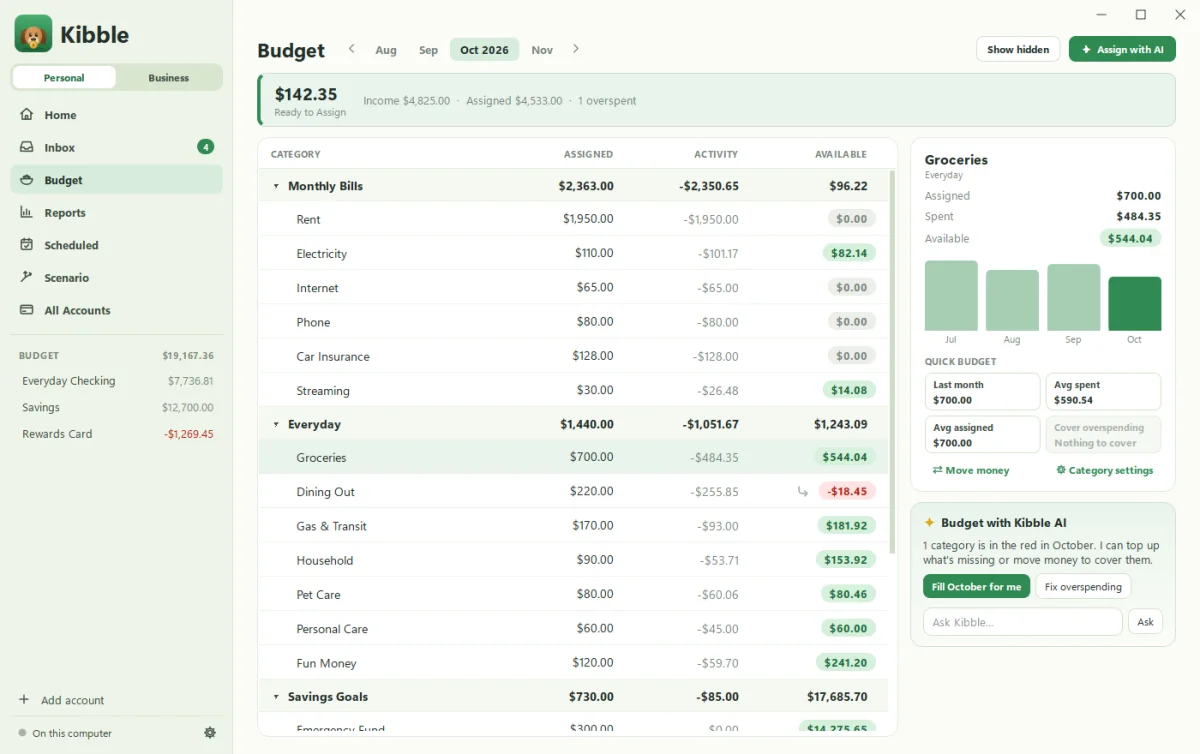
- Ready to Assign shows exactly how much money has arrived and still needs a job. No assigning money you don’t have.
- Fill for me budgets a new month from your last three months, and you approve each line. See Use Kibble AI.
- Fix overspending moves money from where it’s available to where it’s needed, in one click.
- Receipts from Gmail keep your categories accurate without typing every transaction.
- Business mode keeps freelance money fully separate, with invoices, hours, expenses by Schedule C line, and quarterly tax estimates. See Switch on Business mode.
Start with Set up your first budget, or see the honest comparison in Kibble vs budget spreadsheets.
The short version
- Budget money you have, not money you expect.
- Take taxes off the top of every payment.
- Know your baseline and plan around your lowest typical month.
- Build a buffer and pay yourself a steady salary from it.
- Decide your lean month and great month plans in advance.
- Keep business and personal money apart.
Uneven income doesn’t have to mean uneven nerves. Once the buffer is in place, it all gets a lot calmer. Even the dog notices.
Questions people ask
How much should I keep as a buffer with an irregular income?
Aim for one full month of baseline expenses first, then grow it toward three months. The buffer is what turns lumpy income into a steady paycheck.
Should I budget based on my best month or my average?
Neither. Budget your baseline from your lowest typical month. Treat anything above that as extra to assign once it actually arrives.
How much should freelancers set aside for taxes?
Many set aside 25 to 30 percent of profit, but your number depends on your income, deductions and state. Ask an accountant for yours.
Still scratching your head?
Send us a note and a real person will get back to you.