Quarterly taxes for freelancers, explained simply
What estimated taxes are, when they're due, and how to set money aside.

Quarterly estimated taxes are how freelancers and self-employed people pay income tax and self-employment tax during the year, since no employer is withholding it from a paycheck. In the US, you generally need to pay them if you expect to owe $1,000 or more for the year. For the 2026 tax year, the federal due dates are April 15, June 15 and September 15, 2026, and January 15, 2027. A common rule of thumb is to set aside 25 to 30 percent of your profit, but your real number depends on your situation.
This is a plain-words overview, not tax advice. Tax rules have fine print, and an accountant can tailor all of this to you in one conversation.
Why do freelancers pay taxes quarterly?
When you’re an employee, your employer takes taxes out of every paycheck and sends them to the IRS. When you’re self-employed, nobody does that for you. The tax system still expects to be paid as you earn, not all at once in April, so it asks you to send estimated payments four times a year.
What taxes are included?
Two main ones at the federal level:
- Income tax, the same tax everyone pays, based on your total income after deductions.
- Self-employment tax, which covers Social Security and Medicare. As an employee, you and your employer split these. As a freelancer, you pay both halves, about 15.3 percent of most of your net self-employment earnings. You get to deduct half of it on your return, which softens the blow a little.
That second one is why freelancers are often surprised by their first tax bill.
When are quarterly taxes due in 2026?
| Payment | Covers income earned | Due date |
|---|---|---|
| 1st | January 1 to March 31 | April 15, 2026 |
| 2nd | April 1 to May 31 | June 15, 2026 |
| 3rd | June 1 to August 31 | September 15, 2026 |
| 4th | September 1 to December 31 | January 15, 2027 |
Yes, the “quarters” aren’t actually equal. Nobody knows why. Well, somebody does, but they’re not telling. If a due date falls on a weekend or holiday, it moves to the next business day.
How much should I set aside?
The simple approach: every time a client pays you, move a fixed percentage into a separate savings account just for taxes. 25 to 30 percent of profit is a common starting point. Higher earners, people in high-tax states, and anyone with few deductions may need more.
Profit means income minus business expenses. Every legitimate deduction, like software, equipment, a home office or business mileage, lowers the profit your taxes are based on. That’s why tracking expenses all year pays off.
How much do I actually have to pay each quarter?
There are two common ways to figure it out.
The safe harbor way (simpler). You generally avoid an underpayment penalty if you pay, in total for the year, at least:
- 90 percent of this year’s tax, or
- 100 percent of last year’s tax, or 110 percent if last year’s adjusted gross income was over $150,000 ($75,000 if married filing separately).
Many freelancers take last year’s total tax, add the 10 percent if needed, divide by four, and pay that each quarter. You might still owe more in April, but you shouldn’t owe a penalty.
The as-you-go way (more precise). Estimate this year’s profit each quarter and pay a share of the tax on it. This tracks your real income more closely, which helps when income jumps around. The IRS even has a method for lumpy income, called the annualized installment method. It’s worth asking your accountant about it if your income is very uneven.
How do I pay?
Federal estimated taxes can be paid:
- Online through IRS Direct Pay, straight from a bank account.
- Through your IRS Online Account.
- With EFTPS, the Treasury’s electronic payment system.
- By mail, using the vouchers on Form 1040-ES.
Keep a record of each payment, because you’ll report the total on your annual return.
What about my state?
Most states with an income tax have their own estimated tax payments, often due on or near the federal dates. Check your state’s tax agency website. If you live in a state without income tax, enjoy that one.
Common mistakes to avoid
- Spending the tax money. It sits in your account looking available. It isn’t. A separate savings account makes it much less tempting.
- Forgetting self-employment tax. Budgeting only for income tax is the classic first-year surprise.
- Skipping deductions. Software, equipment, a home office, business mileage and health insurance premiums for the self-employed can all lower what you owe. Keep receipts as you go, not in a panic in March.
- Mixing business and personal money. Separate accounts make deductions easier to prove and mistakes easier to spot.
- Waiting for the IRS to remind you. It won’t. Put the four dates in your calendar today.
A simple quarterly routine
- Every payment: move your tax percentage to the tax account right away.
- Every month: record business expenses and mileage.
- Two weeks before each due date: calculate the payment.
- By the due date: pay federal, then state, and record both.
- Every January: handle 1099s, and gather everything for your accountant.
How Kibble helps
Kibble’s Business mode keeps this routine on rails:
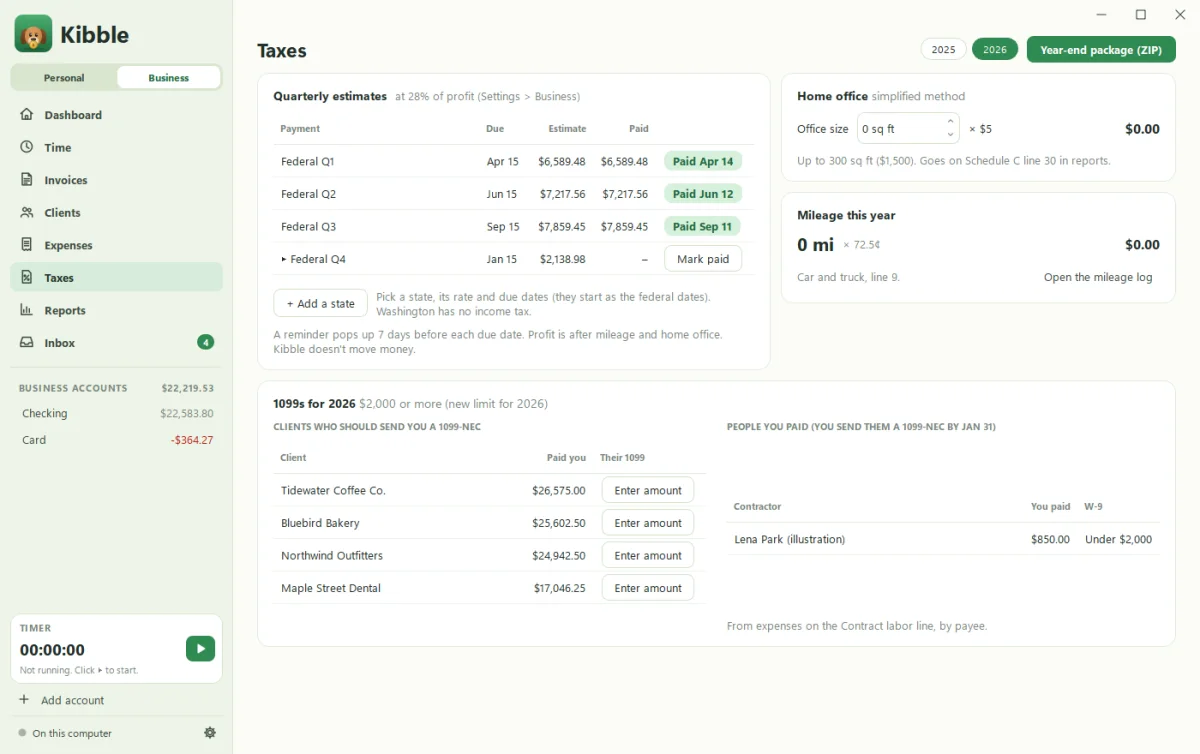
- The Taxes screen estimates each quarter from your profit and the rate you set, for federal and any states you add, and reminds you 7 days before each due date. See Quarterly tax estimates.
- Mileage at the IRS standard rate and a simplified home office deduction lower your profit automatically. See Mileage and home office.
- Mark paid records each payment, so the year-end total is ready.
- In January, the year-end ZIP bundles your Schedule C summary, transactions, mileage log, tax payments and 1099s for your accountant. See 1099s and the year-end ZIP.
Kibble doesn’t pay or file anything. It keeps the numbers straight so April is boring, which is exactly how April should be.
The short version
- Quarterly taxes cover income tax plus self-employment tax.
- 2026 due dates: April 15, June 15, September 15, and January 15, 2027.
- Set aside a percentage of every payment, often 25 to 30 percent of profit.
- Use the safe harbor rules to avoid penalties.
- Track deductions all year, because they lower what you owe.
- When in doubt, ask an accountant. It’s one of the best-value hours you’ll spend.
Questions people ask
What happens if I miss a quarterly payment?
The IRS may charge an underpayment penalty, which works a lot like interest on the amount you were short, for the time you were short. Paying late is better than not paying. Catch up as soon as you can.
Do I have to pay quarterly taxes in my first year freelancing?
Often, yes, if you expect to owe $1,000 or more for the year. The prior-year safe harbor can help, since it's based on last year's tax, which may have been covered by paycheck withholding.
Do states have estimated taxes too?
Most states with an income tax have their own estimated payments, often on similar dates. A few states, like Washington, have no state income tax.
Still scratching your head?
Send us a note and a real person will get back to you.