How to answer "Tell me about yourself" (and practice it)
The first question in almost every interview. A simple formula, three examples, and how to practice out loud.

To answer “Tell me about yourself”, give a 60 to 90 second story in three parts: where you are now, what got you here, and why this role is the next step. Pick details that match the job. Then practice it out loud a few times, because the version in your head is always smoother than the one that comes out of your mouth.
Why they ask
It’s rarely a trick. Interviewers use it to warm up, hear how you talk about your work, and pick what to ask next. A clear answer sets the direction of the whole interview. A rambling one makes them steer.
The formula: present, past, future
- Present. Your current role and one thing you’re proud of. “I’m a customer success manager at a software company, where I look after 40 mid-size accounts. Last year I cut churn in my book by a third.”
- Past. How you got here, in one or two steps that matter for this job. “I started in support, which is where I learned to love fixing problems at the root.”
- Future. Why this role, why now. “I’m looking for a role where I can work on onboarding, and your team’s focus on the first 90 days is exactly that.”
That’s it. Three parts, about 150 to 200 words.
Three examples
Career changer, teacher to instructional designer: “For the past six years I’ve taught high school science, and the part I loved most was designing lessons that worked for every kind of learner. Over the last year I’ve built three online courses for our district, including one now used by 1,200 students. I’m moving into instructional design full-time, and your team’s work on onboarding courses is exactly where I’d like to grow.”
New grad, software engineering: “I just finished a computer science degree at State, where I focused on backend systems. My favorite project was a scheduling app our campus clinic now uses, which cut no-shows by 20%. I also interned at a logistics startup, building APIs. I’m excited about this role because your team works on the kind of reliability problems I want to spend my first years on.”
Experienced hire, marketing: “I lead lifecycle marketing at a subscription company, where my team doubled email revenue in two years. Before that I ran paid search at an agency, which taught me to test everything. I’m looking for a role with a bigger product and more data to play with, and this one fits.”
Common mistakes
- Reading your resume aloud. They have it. Tell the story behind it.
- Starting from childhood. Start with now.
- Going past two minutes. Leave room for questions.
- No link to the job. The future part is what makes it about them.
Practice it out loud
Writing the answer is half the work. Saying it is the other half. Try this:
- Write the three parts on an interview prep sheet.
- Say it out loud and time it.
- Cut anything that made you stumble.
- Say it again, three more times, on different days.
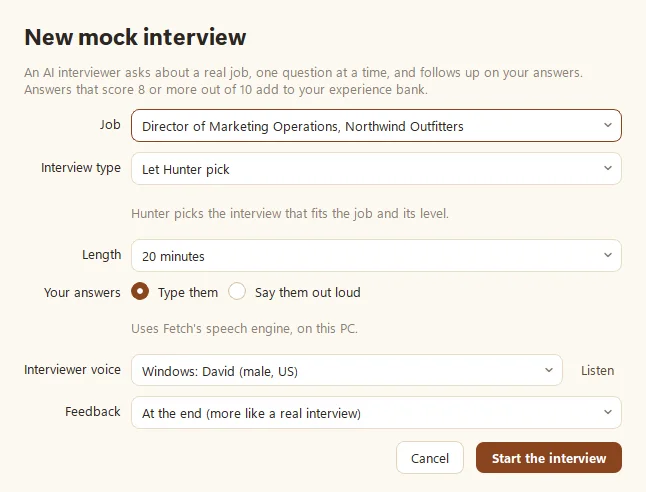
Hunter’s mock interviews let you practice this question and others with an AI interviewer, typing or speaking your answers. You get a scorecard at the end with your pace, filler words and a stronger version of each answer. See Practice a mock interview, and for more questions to rehearse, 10 interview questions to practice out loud this week.
The short version
- Present, past, future, in 60 to 90 seconds.
- Pick details that match the job.
- End with why this role.
- Practice out loud, more than once.
Questions people ask
How long should my answer be?
About 60 to 90 seconds. Long enough to set up the conversation, short enough that they ask a follow-up.
Should I talk about my personal life?
A line is fine if it's relevant or shows something about how you work. Keep the focus on your work and why you want this role.
Should I memorize it word for word?
Memorize the shape, not the script. Know your three parts and a key detail for each, then say it naturally. Practicing out loud a few times gets you there.
Still scratching your head?
Send us a note and a real person will get back to you.