The 15-minute monthly money check-in
Fifteen minutes, once a month, five questions. Here's how to review your budget without dreading it.
To do a monthly money check-in, set aside 15 minutes in the first week of the month and answer five questions about the month that just ended: what did I spend, what went over, what did I save, what’s new or repeating, and what changes next month. Compare each answer with your usual month, not just last month, and write down one or two changes. That’s it.
Why a monthly check-in works
A budget is a plan. A check-in is how you find out whether the plan worked. Without one, small leaks go unnoticed for months: a subscription you forgot, a category that’s quietly creeping up, a “one-time” charge that turns out to repeat.
Once a month is the sweet spot. Weekly is a lot of effort for most people, and once a year is too late to fix anything.
Question 1: What did I spend, compared with usual?
Start with one number: total spending for the month. Then compare it with your usual month, like the average of the last 12.
- About the same: good. Move on.
- Well above: find out why in the next question.
- Well below: nice, but check nothing is missing, like a bill that hasn’t posted yet.
Question 2: What went over?
Go through your categories and look at spent against budgeted. Note anything that went over, and who you paid to get there. “Dining out went over” is vague. “Three takeout orders in the last week” is something you can act on.
Ask of each one: was it a one-off, or is this the new normal? If it’s the new normal, the budget needs to change, not you.
Question 3: What did I save?
Work out what you saved: income minus spending. Then your savings rate: what you saved divided by what came in.
Track both over time. A savings rate that creeps up over the year matters more than any single month. Glance at your net worth too, since it shows whether saving and paying down debt are adding up.
Question 4: What’s new or repeating?
Scan for charges you don’t recognize, and new charges that repeat. This is where forgotten subscriptions and free trials that turned paid hide. Cancel what you don’t use, and add the rest to your budget as a scheduled bill.
Question 5: What changes next month?
Pick one or two changes, no more:
- Move money into a category that keeps going over.
- Take money out of one that’s always well under.
- Plan for a bigger month ahead, like holidays or a yearly bill.
Then set up next month’s budget with those changes in.
How Kibble helps
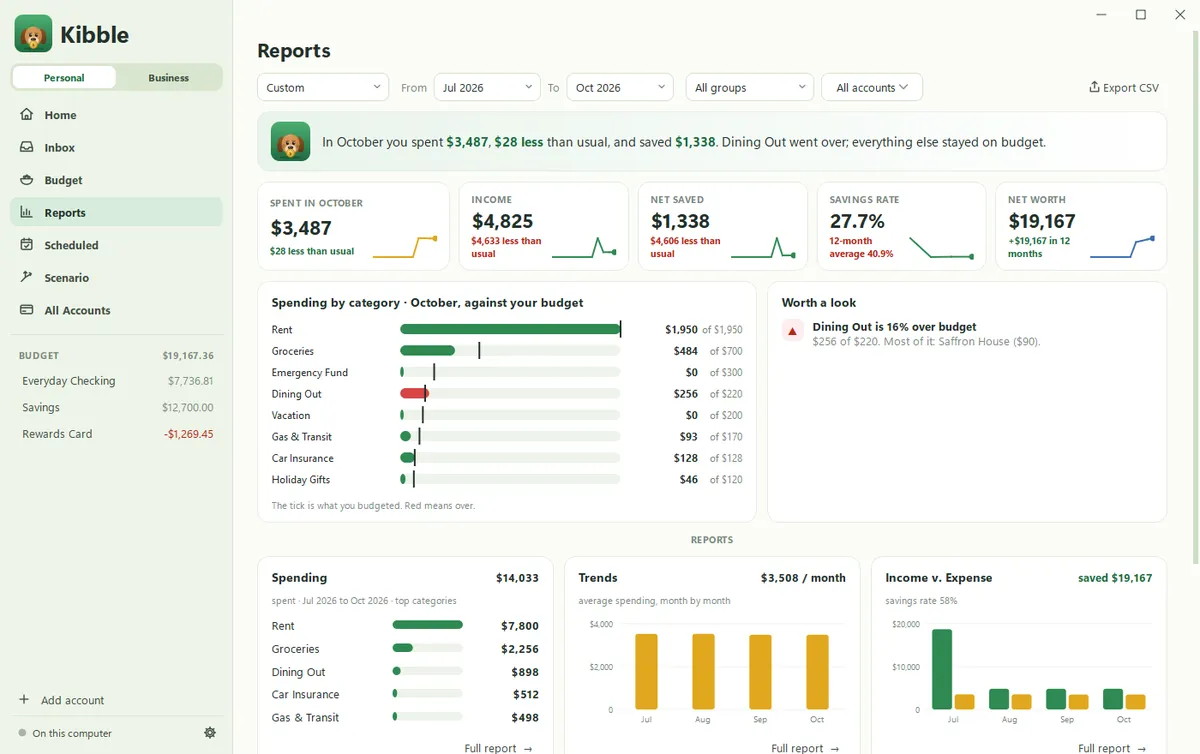
Kibble’s Reports page answers most of these questions before you ask them:
- The month in a sentence: what you spent, how that compares with usual, what you saved and what went over.
- Five cards with trend lines: spent, income, net saved, savings rate and net worth, each against the year before.
- Spending against your budget, with red for anything over.
- Worth a look: what went over budget and the payee behind it, what’s well under usual, and new charges that repeat.
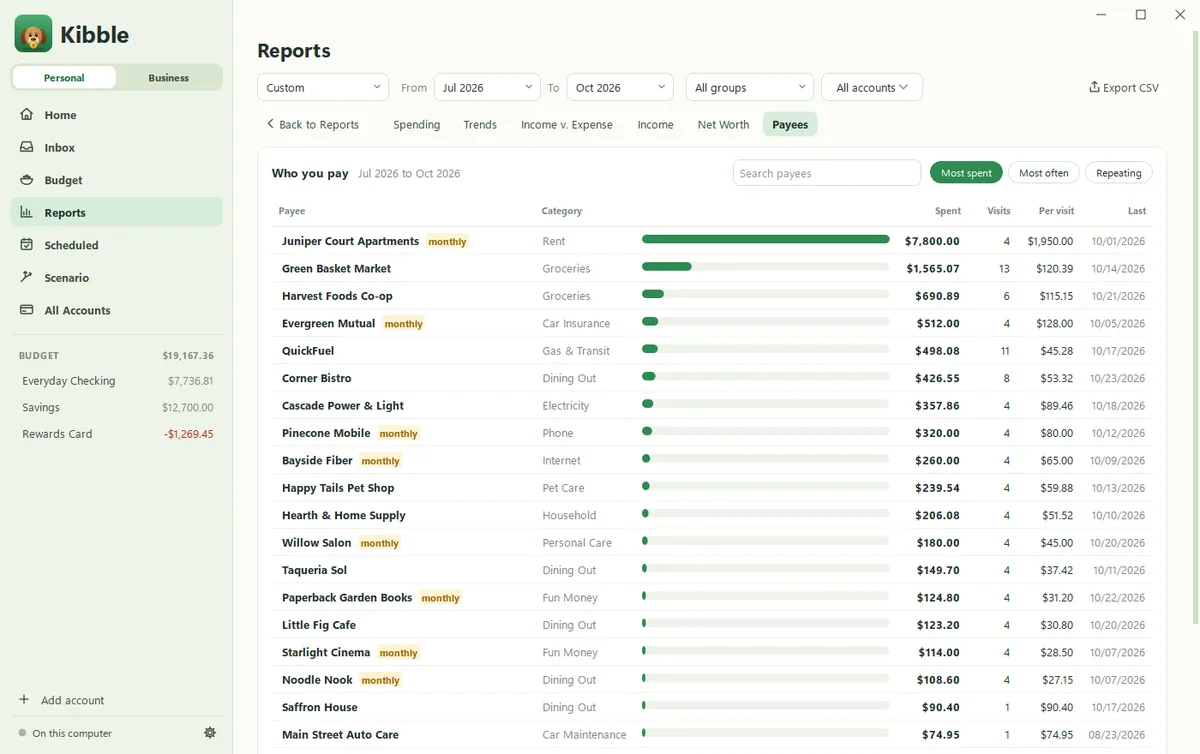
- A full report for each question when you want more detail, like Payees to see who you pay most often.
Kibble also reminds you when it’s time. The first time you open it after a month ends, Month close shows last month’s charges still waiting in the Inbox and anything without a category, then emails you a summary of the month, with your partner or accountant on CC if you like. See Month close and your monthly summary email.
See Read your reports. Then let Kibble AI fill in next month from your last three months, and adjust from there.
The short version
- Fifteen minutes, first week of the month.
- Compare with your usual month, not just last month.
- Find what went over, and who you paid.
- Track your savings rate and net worth over time.
- Cancel what repeats and isn’t used.
- Make one or two changes, then budget next month.
Questions people ask
When should I do a monthly budget review?
In the first few days of the new month, once last month's charges have posted. Put it on your calendar so it happens even in busy months.
What is a good savings rate?
Many people aim for 10 to 20 percent of take-home pay. The trend matters more than any one month, so look for it creeping up over the year.
Should I compare a month with last month or with my average?
With your usual, like the average of the last 12 months. One month is easily skewed by a holiday or a big bill, and an average shows what's really normal for you.
Still scratching your head?
Send us a note and a real person will get back to you.