How to keep your partner in the loop on money, without nagging
One person does the budget, the other hears about it when something goes wrong. A monthly summary fixes that.
To keep your partner in the loop on money, send them a short summary once a month, a few days after the month ends. Keep it to the big numbers: what came in, what went out, what you saved, your net worth, and the one or two categories that went over. Then talk for 10 minutes: what surprised you, and what you’ll change. No spreadsheets, no blame.
Why one person usually ends up “the money person”
In most couples, one person enjoys the budget, or at least puts up with it. That’s efficient, but it has a cost:
- The other person only hears about money when something’s wrong.
- Big decisions feel one-sided, even when they aren’t.
- If the money person gets sick or busy, no one else knows where things stand.
The fix isn’t to split the work in half. It’s to share the picture.
What to put in a monthly money summary
Less is more. Five numbers and a sentence cover it:
- Income: everything that came in.
- Spending: everything that went out.
- Saved: income minus spending, and your savings rate (saved divided by income).
- Net worth: what you own minus what you owe, and whether it went up.
- What went over: the one or two categories that blew past the budget, and why.
Add one sentence that sums it up: “We spent about the same as usual, saved 18%, and dining out went over again.” That sentence is what your partner will remember.
Share it, then talk
Send the summary first, and talk a day or two later. Reading it alone gives your partner time to think instead of reacting on the spot.
When you talk, keep it short and use three questions:
- What surprised you? Start with curiosity, not a verdict.
- What went well? Say it out loud. A month on budget deserves a mention.
- What’s one thing to change? Pick one, not five. Move money into a category that keeps going over, or plan for a big month ahead with a sinking fund.
Rules that keep it friendly
- Talk about categories, not people. “Dining out went over” beats “you spent too much on takeout.”
- Same day every month. A regular talk feels routine. A surprise talk feels like trouble.
- No-judgment money. Give each of you a small amount to spend on anything, no questions asked.
- Agree on what’s shared. If you keep some accounts separate, the summary covers the shared ones.
Who else might want a copy
A monthly summary isn’t just for partners. Freelancers often send one to their accountant or bookkeeper, so tax time holds no surprises. Some people share one with a financial planner, or with a grown child who helps an older parent with money.
How Kibble helps
Kibble’s Month close puts this routine on autopilot:
- Catch the last charges first. The first time you open Kibble after a month ends, it shows anything still waiting in the Inbox and anything without a category, so the numbers are complete.
- A summary email that looks like Kibble: a one-sentence recap, spending, income, savings rate and net worth, top categories against your budget, the month before and the year so far.
- CC your partner or accountant. It’s sent from your own Gmail to yourself, with anyone you add on CC. Nothing is sent until you click Send.
- Business too. If you run a business in Kibble, the email can add revenue, expenses, profit and unpaid invoices, or leave them out.
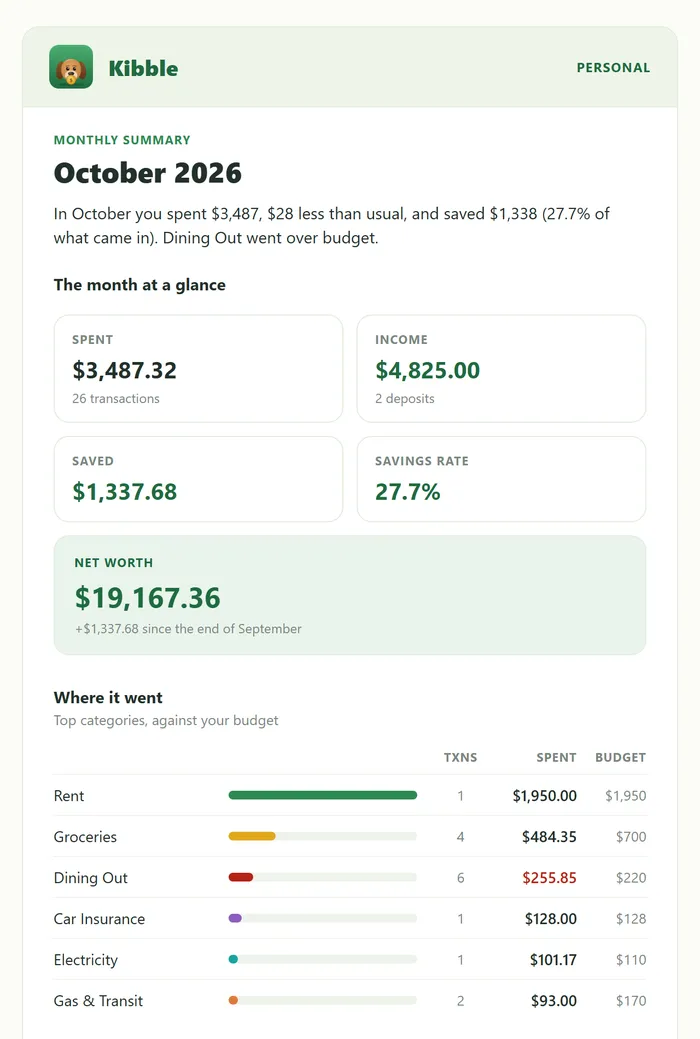
See Month close and your monthly summary email. For your own deeper look each month, try the 15-minute monthly money check-in.
The short version
- Share a summary once a month, a few days after it ends.
- Five numbers and one sentence: income, spending, saved, net worth, what went over.
- Send first, talk later, for 10 minutes.
- Talk about categories, not people, and pick one change.
Questions people ask
How often should couples talk about money?
A short talk once a month works for most couples, a few days after the month ends. Add a longer yearly talk for big goals like a house, kids or retirement.
What if only one of us does the budget?
That's common and fine. The person who runs the budget shares a short summary each month, and the other reads it and asks questions. Both of you should know the big numbers.
Should couples combine their finances?
It's up to you. Some share everything, some keep separate accounts plus a joint one for shared bills. A monthly summary works either way, as long as you agree on what it covers.
Still scratching your head?
Send us a note and a real person will get back to you.