Five minutes before every meeting: the briefing habit
Why a short look back before each call makes meetings shorter.

The briefing habit is simple: spend about five minutes before each meeting reviewing who’s coming, what you talked about last time, and what you want from this one. It makes meetings shorter, because nobody spends the first ten minutes reconstructing context, and warmer, because you remember the people as well as the agenda.
Why do meetings start slowly?
Think about how most calls begin. “So… where did we land last time?” Someone scrolls through an old email. Someone else remembers it differently. Ten minutes later, you’re back where you left off.
That warm-up costs every person on the call. A two-minute briefing on your end can save it for everyone.
The five-minute briefing
Before each meeting, answer four questions.
1. Who’s coming? (1 minute)
Look at the invite. For each person, recall their role, and anything personal they shared last time, like a new puppy, a big launch, or a trip. Opening with “How was Lisbon?” starts a call very differently from “Sorry, remind me what you do?”
2. What happened last time? (2 minutes)
Skim your notes from the last meeting with these people. You’re looking for:
- Decisions made
- Action items, especially yours, and whether you did them
- Open questions left hanging
If you promised something and didn’t deliver, now is the moment to decide what you’ll say. Much better than discovering it live.
3. What do I want from this meeting? (1 minute)
One sentence. “Agree on the launch date.” “Get a yes on the pilot.” “Understand why renewals slowed.” If you can’t write that sentence, the meeting might not need to happen, or it might need a better agenda.
4. What’s my first question? (1 minute)
Have your opening ready. It sets the tone and moves things forward from the first minute.
That’s it. Five minutes, four questions.
A briefing template you can copy
Paste this into your notes app and fill it in before your next call:
Meeting: Customer call: Northwind
Who: Dana Kim (Head of IT, just back from Lisbon), Luis Ortega (procurement)
Last time: They asked about SSO pricing and a 20-seat pilot. I promised a pricing sheet by Friday. Sent it Thursday.
Open questions: Who signs off on the pilot? What’s their timeline?
Goal today: Agree on pilot scope and a start date.
First question: “Did the pricing sheet cover what you needed for SSO?”
Five lines, two minutes, and you walk in sounding like the most prepared person in the room. Because you are.
What if I don’t have notes from last time?
That’s the most common problem, and why the habit fails for most people. You can’t review notes you didn’t take. Two fixes:
- Write three lines after each meeting: decisions, action items, open questions. It takes a minute.
- Let software take them for you. A meeting notetaker records, transcribes and summarizes your calls, so last time’s decisions are always one click away. See How to take meeting notes without typing a word.
Make the briefing come to you
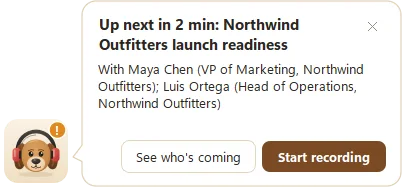
The easiest habit is one you don’t have to remember. With your calendar connected, Fetch pops up shortly before each meeting, two minutes ahead by default, with who’s coming, plus each person’s role or company if Fetch knows them. One click starts recording. See Briefings before your calls.
For the “what happened last time?” part, ask Fetch directly: “What did we decide with Northwind?” It searches your past calls and answers with a link to the exact moment. See Ask your meetings. Each client folder also keeps a running summary of decisions and open questions across all your calls.
Does it really make meetings shorter?
Try it for a week and see. Pick your three most important recurring meetings, brief before each one, and notice how long it takes to get to the real discussion. Then compare it with last week. Most people notice three things fast: calls get to the point sooner, fewer things fall through the cracks, and people start saying “great memory!” You don’t have to tell them your secret. Good dogs never reveal where they buried the bone.
Questions people ask
What if I have back-to-back meetings?
Even 60 seconds helps. Look at who's coming and the last decision you made together. That alone changes the first few minutes of the call.
Should I brief before internal meetings too?
Yes, especially recurring ones. A quick look at last week's action items turns "so, where were we?" into a real update.
Still scratching your head?
Send us a note and a real person will get back to you.