How to track freelance expenses for Schedule C
The Schedule C lines that matter, what receipts to keep, and a 20-minute monthly routine.

To track freelance expenses for Schedule C, keep business spending in a separate account or card, save a receipt or note for every expense, and sort each one into its Schedule C line as you go, not in April. Add mileage and your home office, and do a short review once a month. This is a plain-words guide, not tax advice.
What is Schedule C?
Schedule C is the IRS form US sole proprietors and most single-member LLCs use to report business income and expenses. Income minus expenses is your profit, and both income tax and self-employment tax are figured from it. Every legitimate expense lowers that profit.
The lines most freelancers use
| Line | What goes there | Examples |
|---|---|---|
| 8 | Advertising | Ads, sponsored posts, business cards |
| 9 | Car and truck expenses | Business mileage at the standard rate |
| 10 | Commissions and fees | Marketplace fees, payment processing fees |
| 11 | Contract labor | Subcontractors you paid (think 1099-NEC) |
| 15 | Insurance (not health) | Professional liability insurance |
| 17 | Legal and professional services | Accountant, lawyer |
| 18 | Office expense | Postage, printer ink, small office items |
| 22 | Supplies | Materials used in your work |
| 23 | Taxes and licenses | Business licenses, some fees |
| 24 | Travel and meals | Business travel; meals are generally 50% |
| 25 | Utilities | A business phone line |
| 27a | Other expenses | Software subscriptions, education, bank fees |
| 30 | Business use of home | The home office deduction |
Your accountant may sort a few things differently. Consistency matters more than perfection.
Step 1: Separate the money
Use one bank account and one card for business only. It makes every other step easier. When a statement arrives, everything on it is a business transaction, and you’re not squinting at a grocery receipt wondering if the printer paper was in there.
Step 2: Keep proof for every expense
For each expense, keep what you bought, when, from whom, how much, and why it was for business. A photo of the receipt or the emailed receipt is enough. For meals, add who you met and what you discussed.
Step 3: Log mileage as you drive
If you use your car for business, log each trip: date, where you went, why, and miles. For 2026, the IRS standard mileage rate is 72.5 cents a mile. A log written months later is much harder to defend than one written the same week.
Step 4: Measure your home office
If part of your home is used regularly and only for business, you may qualify for the home office deduction. The simplified method is $5 per square foot, up to 300 square feet, so up to $1,500 a year. It goes on line 30.
Step 5: A 20-minute monthly routine
Once a month:
- Import or download your business account and card statements.
- Give every transaction a Schedule C line.
- Match receipts to anything over a few dollars.
- Add mileage for the month.
- Check profit, and move your tax set-aside. Our quarterly tax calculator can help pick the amount.
Do that twelve times and tax season becomes an afternoon, not a weekend.
Common mistakes
- Mixing personal and business spending on the same card.
- Forgetting small recurring costs, like software, that add up over a year.
- Skipping mileage because the trips felt short.
- Deducting personal things. Your gym probably isn’t a business expense, however good it is for your mood.
- Losing 1099-NEC records for contractors you paid. See 1099-NEC.
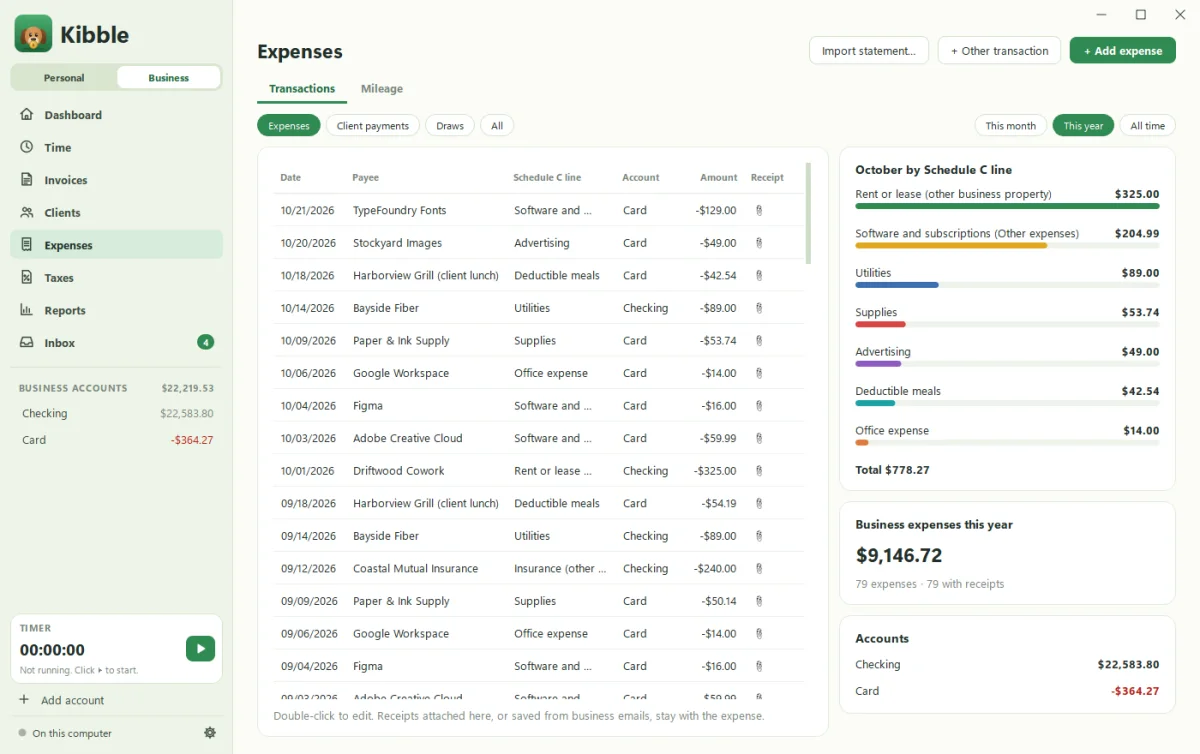
How Kibble helps
Kibble’s Business mode does this routine with you:
- Statement import from CSV or QFX, with duplicates skipped and the ending balance checked. See Import bank and card statements.
- Schedule C lines suggested for each expense and remembered per payee.
- Receipts attached to expenses, including business receipts from your email.
- Mileage at the 2026 rate and the simplified home office deduction. See Mileage and home office.
- A year-end ZIP with the Schedule C summary, every transaction, the mileage log and receipts for your accountant. See 1099s and the year-end ZIP.
The short version
- Separate account, receipt for everything, Schedule C line on every expense.
- Log mileage the same week, and measure your home office.
- Twenty minutes a month beats a lost weekend in April.
Questions people ask
How long should I keep receipts?
The IRS generally says to keep records for 3 years from when you file, and longer in some cases, such as 7 years for certain losses. Many people simply keep everything for 7 years. Digital copies are fine.
Can I deduct meals with clients?
Business meals are generally 50 percent deductible, with a note of who you met and what you discussed. Entertainment generally isn't deductible.
Do I need a separate business bank account?
It isn't required for a sole proprietor, but it makes tracking far easier and your records more convincing. Most accountants recommend one.
Still scratching your head?
Send us a note and a real person will get back to you.