How to write resume bullets that show results, not just duties
Turn "responsible for" lines into bullets that show what changed because of you.
A strong resume bullet says what you did and what changed because of it. The simple recipe: a strong verb, the thing you did, and the result, with a number if you have one. “Responsible for onboarding” tells a recruiter your job title. “Redesigned onboarding from 9 steps to 4, lifting activation 18%” tells them why they should call you.
Why “responsible for” doesn’t work
Recruiters skim. A line that lists a duty could describe anyone who held that job, including someone who did it badly. A line with a result is about you. It answers the question every hiring manager is quietly asking: “What will this person get done here?”
The recipe: verb, action, result
- Start with a verb that says what you did: built, led, cut, launched, grew, fixed, redesigned.
- Say what you did, in plain words. One thing per line.
- End with the result: what got faster, bigger, cheaper, easier, or happened for the first time.
If that sounds like the STAR method squeezed into one line, it is. The situation and task are usually clear from the job. The action and result are what the line is for.
Before and after
| Before | After |
|---|---|
| Responsible for the design system. | Built a Figma design system now used by 6 product teams, cutting new screen design time about 30%. |
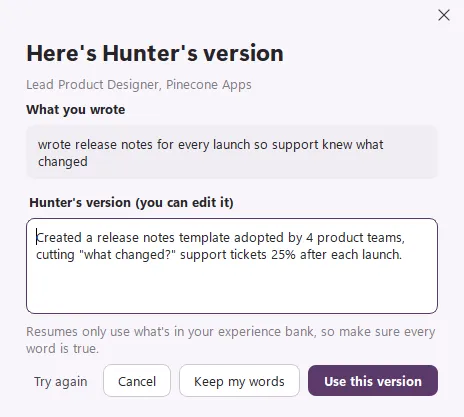
| Wrote release notes for launches. | Created a release notes template adopted by 4 product teams, cutting “what changed?” support tickets 25%. |
| Managed the marketing budget. | Ran a $1.2M marketing budget and moved 20% of spend to the channels that brought in the most pipeline. |
| Helped new hires get started. | Mentored two designers through weekly critiques; both were promoted within 18 months. |
Same jobs, same facts. The after column just says what happened.
Questions that find the result
When a line feels flat, ask yourself:
- What changed after I did this? What was it like before?
- How many? People, teams, customers, deals, tickets, pages, countries.
- How much or how fast? Time saved, money saved or earned, a percentage up or down.
- Who used it or benefited? Did anyone else adopt it?
- Was it a first? First launch, first hire, first time a process existed.
You won’t have a number for everything, and that’s fine. “Became the template every new project starts from” is a result too.
Keep it true
A result you can’t explain in an interview is worse than no result. Round honestly (“about 30%”), know where the number came from, and never borrow a team’s win as your own. Say “helped” or “with the team” when that’s what happened. More on this in How to tailor your resume for every job without stretching the truth.
Write them while you remember
The best time to write a bullet is the week something ships, not three years later when you’re job hunting. Keep a running list of wins with the numbers, even rough notes. When it’s time to apply, you’re choosing from good material instead of trying to remember it.
How Hunter helps
In Hunter, every job in your experience bank has a box where you type what you did in plain words. Click Help me improve it and Hunter asks you 1 to 3 questions, like the ones above, then writes a stronger line. You see your words and Hunter’s version side by side and choose which to keep. Critique my resume goes further: it looks up best practices for your title and suggests better lines across your whole bank. See Build your experience bank and Critique your resume.
The short version
- Verb, what you did, what changed.
- Add a number when you have one, and count something when you don’t.
- One thing per line, three to five lines for recent jobs.
- Keep every word true, and write wins down while they’re fresh.
Questions people ask
What if I don't have numbers?
Use the next best thing. Count something (people, teams, customers, projects), compare before and after ("from weekly to daily"), or name who it helped. A rough, honest estimate like "about 30%" is fine if you can explain how you got it.
How many bullets should each job have?
Three to five for recent jobs, one or two for older ones. Pick the ones that matter most for the jobs you want, not everything you did.
Should every bullet start with a verb?
Most should. A strong verb ("built", "cut", "led", "launched") gets to the point. Just avoid repeating the same one down the page.
Still scratching your head?
Send us a note and a real person will get back to you.